
Every booster club has run a car wash. Six hours, twenty volunteers, four hundred dollars. Everybody’s tired and the team still needs warm-ups.
There’s a better way to think about this, and it starts with a distinction most clubs never make: there is fundraising that raises money, and there is fundraising that moves product. They’re different jobs, they need different plans, and mixing them is why so many booster efforts feel like a lot of work for not much return.
The problem with the car wash
The car wash raises money. So does the bake sale, the raffle, the golf scramble. Money goes into an account, and later somebody writes a check for gear.
That’s fine, and it works. But it has two hidden costs.
The labor is enormous relative to the return. Twenty parent-hours for four hundred dollars is twenty dollars an hour of donated time. Those same parents would often rather write a check than give up a Saturday.
And it front-loads all the risk onto the club. You raise money first, guess at what you’ll need, then buy. If you over-order you’re stuck with sizes nobody wants. If you under-order you’re back to fundraising.
The alternative: sell the thing you were going to buy anyway
A spirit wear program flips the order of operations. Instead of raising money and then buying gear, you sell gear and keep the margin.
Here’s the shape of it. Your program picks a design — school mark, mascot, a slogan the kids actually say. You put it on a small range of items: a tee, a hoodie, a cap, maybe a sideline jacket. Families order and pay up front. The order goes to production as one run. Nobody carries inventory.
A family pays thirty-five dollars for a hoodie. The club’s cost is around twenty-two. The club keeps thirteen. Sell two hundred hoodies across a season — which is not many across a school of a thousand — and that’s twenty-six hundred dollars from an activity that required no Saturdays.
And critically: the parents wanted the hoodie. You didn’t ask them for a donation. You sold them something their kid will wear.
Five things that separate the programs that work from the ones that don’t
1. Fewer items, not more. The instinct is to offer everything — twelve products, six colors, and a catalog. What actually happens is decision paralysis and a fulfillment nightmare. Three to five items. One or two colorways. Done.
2. A real deadline. Open orders for two weeks and close them. Not “ordering is open” indefinitely. A deadline produces orders; an open window produces “I’ll do it later,” and later never comes. Programs that run a hard two-week window consistently outsell programs that leave a form up all season.
3. Pre-sell, don’t stock. Collect orders and payment first, produce once, distribute. No inventory risk, no leftover smalls, no money tied up in boxes in somebody’s garage. The only reason to hold stock is if you’re selling at home games — and then it should be a small, deliberate quantity of your best seller.
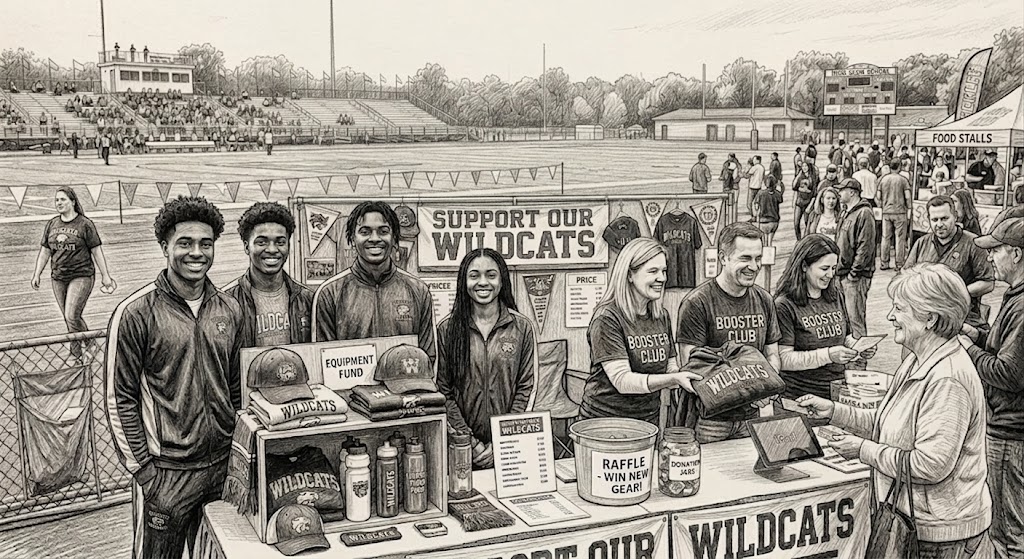
4. Sell at the events you already have. Home games, back-to-school night, parent meetings, the season kickoff. You have a captive audience of exactly the right people several times a season and most clubs sell nothing at them. A table and a card reader at three home games will beat a car wash.
5. Give the money a name. “Fundraiser” is abstract. “New warm-ups for the varsity squad” is not. People give more, and more willingly, when they can see what they’re buying. Say the number out loud: we need $4,200 for warm-ups, this hoodie sale gets us $2,600 of it.
The seasonal calendar nobody uses
Most clubs fundraise when they realize they need money, which is usually too late. There’s a rhythm to the school year that works much better:
August and September — the highest-energy weeks of the year. New season, new families, everyone optimistic. This is when spirit wear sells. Run your main sale now.
October and November — home games and playoff runs. Sell at events. If the team is winning, championship gear moves fast, but you have to have decided in advance what you’d print.
December — holiday gift window. Mini balls, signed keepsakes, gift cards. Small money, easy sales.
February and March — banquet and awards season. Senior gifts, plaques, keepsake items. Also when you should be planning next year’s spirit wear, not next month’s.
April and May — spring sports and end-of-year. Lower energy, but a good window for a final push and for collecting sizes for next fall.
What to avoid
Don’t put the school’s trademarked logo on anything without permission. Districts and schools license their marks, and a booster club printing an unauthorized logo creates a real problem for the athletic director who has to explain it. Ask first. It’s usually a form.
Don’t let one parent front the money. It happens constantly — a well-meaning parent puts an order on a personal card expecting to be reimbursed. When sales come in short, that relationship gets damaged. Pre-sell so the money exists before the order is placed.
Don’t run three fundraisers at once. Families have a finite amount of goodwill and a finite budget. A spirit wear sale, a raffle, and a restaurant night in the same month means all three underperform.
Don’t guess at sizes. Collect them. A run of gear that skews wrong on sizing is money you can’t get back.
The short version
Sell things people want instead of asking for donations. Keep the range small and the deadline real. Take payment before you produce. Use the events you’re already running. And do it in August, not November.
The RUN outfits athletic programs, clubs, and booster organizations out of Fort Worth. We handle spirit wear programs end to end — design, pre-sale, production, and delivery — with no inventory risk to your club. Quotes back within 24 hours.
Request a Quote · 817.668.2600