

The American South has long been a fertile ground for athletic talent. From small towns to urban centers, generations of athletes have emerged with a distinct combination of physical ability, competitive edge, and cultural fluency in sport. This reality invites a deeper question: why here?
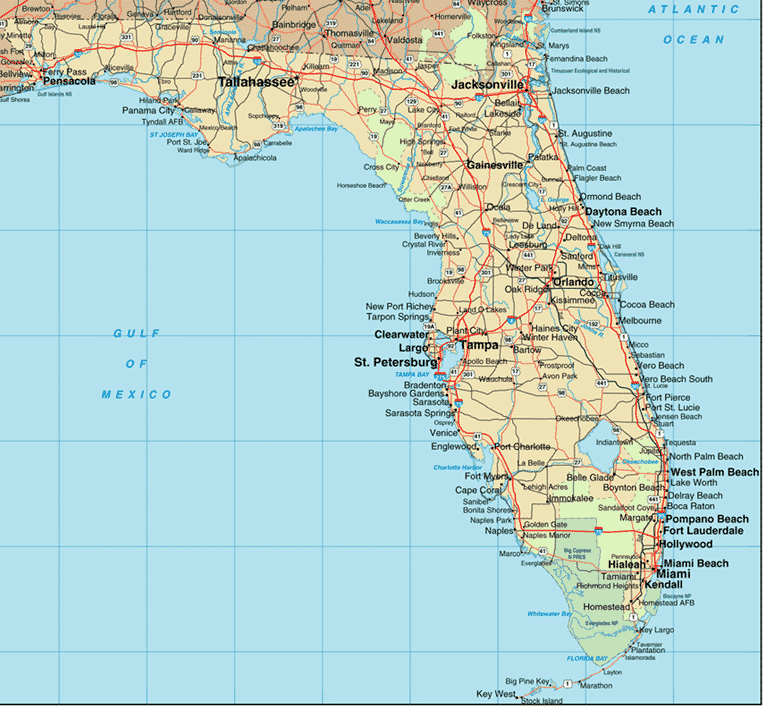
Florida has produced a remarkable lineage of both black and white athletes, shaped by a mix of climate, culture, and history. From segregated leagues and schools in the early 20th century to the eventual integration of high school and college sports, the state became a proving ground where talent had to fight for recognition and space. Notables include Deion Sanders (Fort Myers), Ray Lewis (Lakeland), Emmitt Smith (Pensacola), Ken Griffey Jr. (Orlando), Alex Rodriguez (Miami), Gary Sheffield (Tampa), Tracy McGrady (Bartow), Vince Carter (Daytona Beach), and Amar’e Stoudemire (Lake Wales).
To understand it, one must look beyond surface-level explanations and into the layered history of the region. The South’s social and economic structure was profoundly shaped by the institution of slavery, starting with the breeding of Africans. Remember, these breedings were strategic. Tall, strong, robust men were studded out, intentionally creating strong humans but accidentally creating superior athletes.

Systems of segregation and economic constraint followed this. These systems did not simply disappear; they reorganised communities, access to opportunity, and the pathways through which individuals could pursue advancement. In many Black communities across the Deep South, sport became one of the most visible and viable routes toward mobility—socially, economically, and culturally.

Georgia started life as a penal colony for European settlers before becoming a place of prosperity for African people. Athletes like Herschel Walker (Wrightsville), Calvin Johnson (Tyrone), Champ Bailey (Folkston). Cam Newton (Atlanta), Terrell Davis (San Diego/Lithonia), Eric Berry (Fairburn), NFL safety, Dwight Howard (Atlanta), Anthony Edwards (Atlanta), Lou Williams (Memphis/Snellville), Jaylen Brown (Marietta), Maya Moore (Lawrenceville), Jackie Robinson, Frank Thomas (Columbus), Dansby Swanson (Kennesaw), Terry “Hulk” Hogan (Augusta), Wyomia Tyus (Griffin), and Coco Gauff (Atlanta/Delray Beach).
This does not mean that athletic ability itself is a “product” of slavery. That claim oversimplifies both human capability and history.
This does not mean that athletic ability itself is a “product” of slavery. That claim oversimplifies both human capability and history. What can be said, however, is that historical constraints often shape modern incentives. When access to resources—education, capital, networks is uneven, communities adapt by investing heavily in the avenues that remain open. The Deep South is the poorest region in the country. It’s also the least educated, with the fewest resources, human or otherwise. Sports tend to be the outlet that levels the playing field between the haves and have-nots.
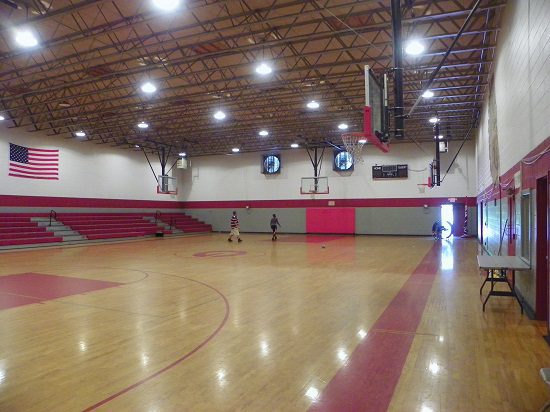
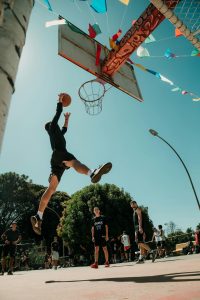
Hank Aaron (Mobile), Willie Mays (Westfield), Gunnar Henderson, Bo Jackson (Bessemer), Julio Jones (Foley), Bart Starr (Montgomery), Shaun Alexander (Florence), Philip Rivers (Decatur), Charles Barkley (Leeds), DeMarcus Cousins (Mobile), Ben Wallace (White Hall), Jesse Owens (Oakville), Carl Lewis (Birmingham), Mia Hamm (Selma), Deontay Wilder (Tuscaloosa), Joe Louis (Lafayette) and Evander Holyfield (Atmore) are some of Alabama’s best. Image is Godwyn Community Center (Montgomery, Alabama)
Over time, this creates a reinforcing cycle:
- Young athletes see visible success stories
- Communities build identity around sport
- Informal systems of development (parks, school programs, mentorship) emerge
- Talent is identified and cultivated earlier and more intensely
The result is not accidental. It is structural.
There is also a cultural dimension. Sport in the South is not merely recreation—it is ritual, status, and storytelling. Friday night lights, packed gyms, and community pride turn performance into something larger than the individual. Athletes are not just participants; they are representatives of place.

Mississippi doesn’t turn out a lot of players, but when they do, he or she is special. Football Jerry Rice (Crawford), Walter Payton (Columbia), Brett Favre (Kiln), Eli Manning (Oxford/Ole Miss), Steve McNair (Mount Olive), Jackie Slater (Jackson), A.J. Brown (Starkville), D.K. Metcalf (Oxford), Roy Oswalt (Weir), Jake Mangum (Mississippi State), Henry Armstrong (Columbus), Tori Bowie (Sand Hill) and Ralph Boston (Laurel). Outdoor basketball court
Clarksdale Mississippi Court
Over time, At the same time, it is critical to acknowledge the limits of this pathway. When entire regions disproportionately channel their youth toward athletics as a primary route to success, it reflects both the power of sport and the absence of equally visible alternatives. The same historical forces that elevated sport as an opportunity also constrained the diversification of opportunity.
So when we talk about “Deep South talent,” we are not pointing to a single origin. We are describing a system shaped over generations—one where history, environment, and culture converge to produce high-level athletes at scale.
The more important question is not where the talent comes from, but how it is supported going forward.

Randy Livingston, Kelly Oubre, Peyton Manning (New Orleans), Terry Bradshaw (Shreveport), Marshall Faulk (New Orleans), Odell Beckham Jr. (Baton Rouge), Justin Jefferson (St. Rose), Dak Prescott (Sulphur), Bill Russell (Monroe), Karl Malone (Summerfield), Bob Pettit (Baton Rouge), Elvin Hayes (Rayville), Ron Guidry (Lafayette), Mondo Duplantis (Lafayette), Dustin Poirier (Lafayette), and Vida Blue (Mansfield) are from Louisiana.
Because if the same intensity, structure, and belief that exist in Southern sports culture were applied across multiple domains—education, business, health—the region would not only produce great athletes.


Leave a Reply