
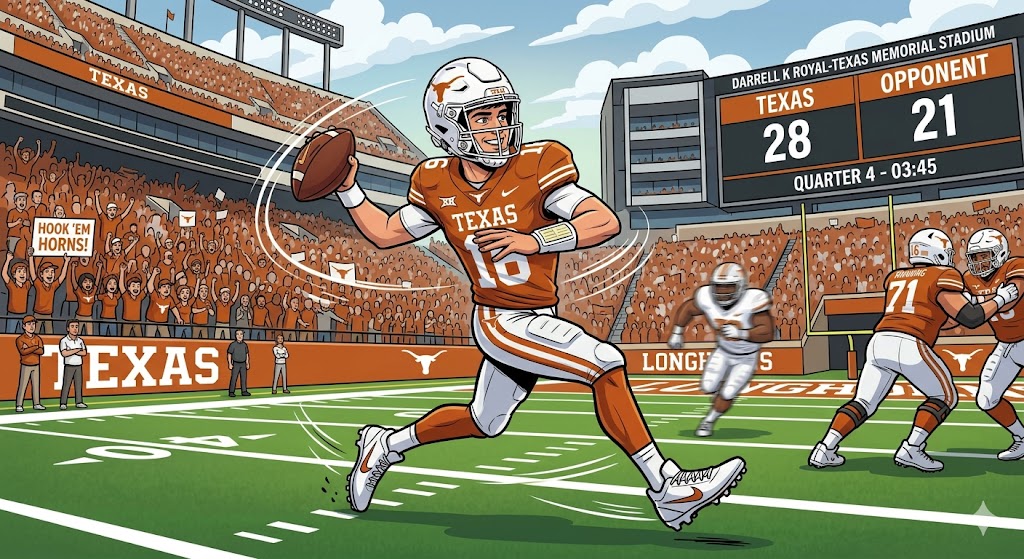
We need a clearer understanding of the difference between the Collective and NIL. Few players fit the true NIL, but almost every football and basketball player fits in the space of the school playing through the collective. Arch Manning exists at the intersection of legacy, leverage, and a rapidly evolving economic structure in college athletics. We will go into the collective in a different article, but understanding how NIL (Name, Image, and Likeness) has worked for him is to understand not just a player but a case study in restraint—arguably more valuable than exploitation in the current era.
Arch Manning arrived at the University of Texas as perhaps the most scrutinized and sought-after high school quarterback since LeBron James was a high school forward. Yet unlike many top-tier recruits in the NIL era, Manning did not immediately flood the market with endorsements. This was not due to lack of opportunity—his last name alone, tied to Peyton Manning and Eli Manning, represents generational brand equity. Instead, his approach has been defined by strategic scarcity.
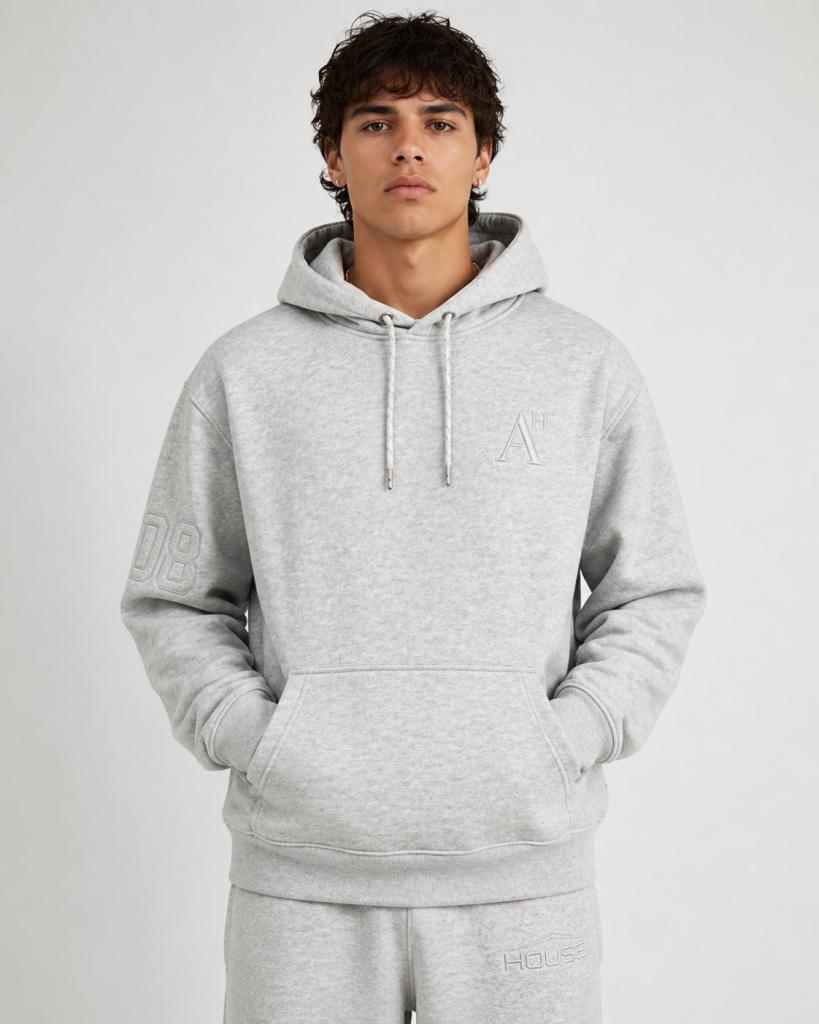
Alfred’s House
Apex Hoodie
Minimalist varsity hoodie with signature embossed logo on the rear.
NIL, in theory, is a democratizing force. It allows athletes to monetize attention, turning social capital into financial capital. But for Manning, the calculus is inverted: his value is not derived from immediate visibility but from the preservation of mystique. While peers capitalize on viral moments and aggressive brand partnerships, Manning’s minimalistic NIL footprint has functioned as a signal—one that communicates confidence in long-term value over short-term gain.
This strategy mirrors principles found in luxury branding. High-end brands do not saturate markets; they curate access. Manning, whether by personal philosophy or family guidance, has treated his name similarly. By limiting endorsements early in his college career, he has avoided the dilution that often accompanies overexposure. In doing so, he has positioned himself less as a college athlete chasing relevance and more as a pre-professional entity managing a portfolio.
There is also a structural advantage at play. Unlike many NIL beneficiaries who rely on earnings as a form of economic necessity, Manning operates from a position of financial insulation. This allows for selectivity—a privilege that transforms NIL from a survival mechanism into a strategic tool. Where others must say yes, he can afford to say no. And in markets, the power to refuse is often the ultimate form of leverage.
Unlike many NIL beneficiaries who rely on earnings as a form of economic necessity, Manning operates from a position of financial insulation.
Moreover, his situation reveals an under-discussed dimension of NIL: not all value is transactional. By abstaining from frequent deals, Manning has arguably increased the perceived worth of any future partnership. Brands are not just buying reach; they are buying association with discipline, patience, and pedigree. In a crowded NIL marketplace, those traits differentiate more than follower counts.
Critically, this does not mean NIL has been irrelevant to him—it has simply been latent. The infrastructure exists, the opportunities are abundant, but the activation has been measured. This stands in contrast to the dominant narrative that NIL success is defined by volume of deals or immediate earnings. Manning challenges that assumption by demonstrating that timing, narrative control, and brand positioning may ultimately yield greater returns.
In a broader sense, Arch Manning represents a second phase of the NIL era. The first phase was defined by exuberance—athletes rushing to monetize a newly opened market. The emerging phase, exemplified by Manning, is one of sophistication. It recognizes that NIL is not just about access to money, but about the management of identity in a public economy.
If the early NIL landscape rewarded visibility, the next may reward discipline. And in that shift, Arch Manning is not just participating in the system—he is quietly redefining how it can be mastered.